Showing posts with label Sience. Show all posts

Study Sheds Light on How Birds Navigate by Magnetic Field


Study Sheds Light on How Birds Navigate by Magnetic Field - Two researchers at Baylor College of Medicine have identified cells in pigeons’ brains that serve as a kind of biological compass.

Birds are famously good navigators. Some migrate thousands of miles, flying day and night, even when the stars are obscured. And for decades, scientists have known that one navigational skill they employ is an ability to detect variations in the earth’s magnetic field.


Nigel Roddis/Reuters


iStock


Pigeons are able to record detailed information on the earth's magnetic field, according to a new study.

How this magnetic sense works, however, has been frustratingly difficult to figure out.

Now, two researchers at Baylor College of Medicine, Le-Qing Wu and David Dickman, have solved a central part of that puzzle, identifying cells in a pigeon’s brain that record detailed information on the earth’s magnetic field, a kind of biological compass.

“It’s a stunning piece of work,” David Keays of the Institute of Molecular Pathology in Vienna wrote in an e-mail. “Wu and Dickman have found cells in the pigeon brain that are tuned to specific directions of the magnetic field.”

Their report appeared online in Science Express on Thursday. Kenneth Lohmann at the University of North Carolina at Chapel Hill, who also studies magnetic sensing, said in an e-mail that the study was “very exciting and important.”

Navigating by magnetism includes several steps. Birds have to have a way to detect a magnetic field, and some part of the brain has to register that information; it seems likely that another part of the brain then compares the incoming information to a stored map.

The Baylor researchers have offered a solution to the middle step. They identified a group of cells in the brainstem of pigeons that record both the direction and the strength of the magnetic field. And they have good, but not conclusive, evidence to suggest that the information these cells are recording is coming from the bird’s inner ear. Dr. Dickman said this research “is still something we want to pursue.”

They did not work on the third step, but Dr. Dickman said a good candidate for the location of that map was the hippocampus, the brain region involved in memory of locations in both birds and humans.

A well-known and often-mentioned study of London taxi drivers showed that experienced drivers with a mental map of London had a hippocampus larger in one area than people without their experience. In some birds that hide seeds and return later to their caches with astonishing accuracy, the hippocampus grows and shrinks seasonally, presumably as they map their hiding spots.

Efforts to understand the magnetic sense in birds have gone in several directions. Some researchers have offered evidence for chemical reactions in the eyes sensitive to magnetic signals, while others have looked at neurons in the beak that they thought contained minute amounts of magnetite, a mineral that is affected by magnetic fields.

Just a few weeks ago, Dr. Keays and colleagues reported in the journal Nature that the idea of neurons in the beak was a nonstarter.

The Baylor researchers did a kind of step-by-step tracking of what areas in pigeons’ brains were responding to variations in an artificial magnetic field that they created. They focused on activity in the brainstem, one of the most primitive parts of the brain, partly because in earlier work they had shown that this area of the brain received signals from a part of the inner ear.

By looking at specific neurons in this part of the brain, the researchers found that the bird’s orientation determined which neurons were active. Each neuron was tuned to respond to signals from one direction. The neurons also registered the strength of the magnetic field.

Other brain regions are also active in response to magnetic stimulation and may be involved in the magnetic sense, Dr. Dickman said. And although he does not provide an answer to how birds detect magnetism, the research clearly falls on one side of a debate over whether magnetite is involved, or whether chemical reactions in the eye may be the key.

Dr. Keays said the research gave strong support to the magnetite idea and the hypothesis that “a population of undiscovered magnetoreceptive cells reside in the pigeon’s ear.”

As Dr. Lohmann said, the discovery “will no doubt inspire much additional work in the future.” ( nytimes.com )

This article has been revised to reflect the following correction:

Correction: April 30, 2012
An article on Friday about a magnetic sense that helps birds navigate misidentified an iron-containing substance found in a recent analysis of beaks.

READ MORE - Study Sheds Light on How Birds Navigate by Magnetic Field

Dinosaur-Era Insects Frozen in Time During Oldest Pollination


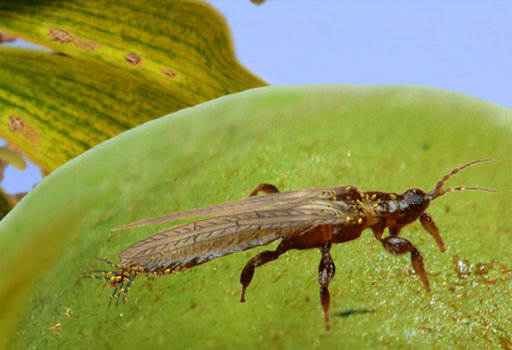
Dinosaur-Era Insects Frozen in Time During Oldest Pollination - With massive dinosaurs towering above, tiny female insects called thrips had just dusted themselves with hundreds of pollen grains from a gingko tree more than 100 million years ago when they perished, only to be preserved in tree resin called amber.

The discovery, detailed this week in the journal Proceedings of the National Academy of Sciences, is the oldest known record of insect pollination.


Dinosaur-Era Insects Frozen in Time During Oldest Pollination
Reconstruction of Gymnospollisthrips with pollen attached to the body over an ovulate organ of a gingko.

Dinosaur-Era Insects Frozen in Time During Oldest Pollination
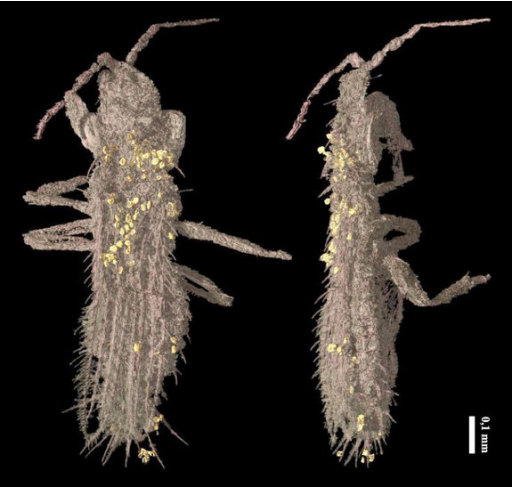
A synchrotron X-ray image of the specimen of Gymnospollisthrips minor, showing the pollen grains (yellow) covering its body.

(Pollination occurs when either the wind or an animal, mostly insects, deliver pollen from a plant's male reproductive organ to the female parts either on the same plant or another one.)

During the lower Cretaceous Period when the newly discovered thrips lived, flowering plants would have just started to diversify, eventually replacing conifers as the dominant species, the researchers said.

"This is the oldest direct evidence for pollination, and the only one from the age of the dinosaurs," study researcher Carmen Soriano said in a statement. "The co-evolution of flowering plants and insects, thanks to pollination, is a great evolutionary success story."

Soriano and an international team of scientists studying the two pieces of amber, which were discovered in what is now northern Spain, say the specimens date back between 110 million and 105 million years ago.

They found six female thrips, also called thysanopterans, enclosed in the amber, with hundreds of pollen grains attached to their tiny bodies — the insects are just 2 millimeters long. The thrips, the researchers found, belong to a new genus now named Gymnopollisthrips, with two new species, G. minor and G. major.

After the amber pieces' initial discovery, they were then kept in a collection of the Museo de Ciencias Naturales de Álava in Spain.

To get a closer look at the pollination event frozen in time, the team used synchrotron X-ray tomography at the European Synchrotron Radiation Facility (ESRF), focusing on the most representative of the amber-encapsulated thrips. In synchrotron X-ray tomography, charged particles are sent speeding through magnetic fields; these particles release high-energy light that can then pierce opaque materials to reveal three-dimensional, high-resolution images.

The images revealed various features of the pollen grains, together suggesting the grains came from a kind of cycad, or gingko, tree, the researchers said. Gingkos have separate male and female trees, with males producing small pollen cones and females bearing ovules at the ends of stalks that develop into seeds after pollination.

The researchers wondered what these pollen transporters would've gotten in return for their services so long ago. The benefit must have been the opportunity to pick up pollen food for the thrips' larvae, said the researchers, adding that this benefit would have nudged the emergence of the ringed hairs specialized for pollen transport.

"Thrips might indeed turn out to be one of the first pollinator groups in geological history, long before evolution turned some of them into flower pollinators," Soriano said. ( LiveScience.com )

READ MORE - Dinosaur-Era Insects Frozen in Time During Oldest Pollination

Cocoa Enjoys a Rich Reputation as Medicine


Cocoa Enjoys a Rich Reputation as Medicine - It may be chic to pop a piece of dark chocolate in the name of living longer, but there's nothing nouveau about cocoa's reputation and role as medicine in many different cultures.


http://0.tqn.com/d/longevity/1/G/N/3/-/-/Getty-chocolate-drink.jpg

According to a historical review compiled by a team of more than 100 researchers, led by University of California (Davis) nutrition professor Louis Grivetti, chocolate was first credited with improving longevity around 1660 - but its origins date back centuries earlier. Entitled Food of the Gods: Cure for Humanity? A Cultural History of the Medicinal and Ritual Use of Chocolate, the paper traces the cocoa plant from its earliest cultivation, to today, chronicling its use to treat dozens of ailments including rheumatism, seizures, syphilis, ulcers, and perhaps more surprisingly, given our current knowledge that chocolate contains caffeine, heart palpitations, and insomnia!

According to the research, published in the Journal of Nutrition, cocoa's story begins with cultivation by the Mayan, Olmec, and Aztec cultures, although exactly where domestication began is unclear. Seeds of the berry-like fruit of the theobroma cacao plant, now referred to as cocoa "beans," were used as currency, offered as sacrifices to deities, and ground into beverages, the remains of which have been discovered at archeological sites in what is now Honduras, dating back 3,000 years.

Chocolate's modern history as food and medicine began around the early 1500s, with the arrival of Spanish explorers to the Americas. In some of the earliest documentation in a western language, Hernando Cortez and Bernal Diaz del Castillo wrote about chocolate's role in the local economy, and culture of the indigenous peoples.

Within a century, cocoa was enjoying widespread use in Spain, France, England and other parts of western Europe. Its medical applications were influenced by extensive documentation of how cocoa was used by the Aztecs, most notably in a 60-year compilation of cultural, dietary and health practices tirelessly assembled by the Spanish priest Bernardino de Sahagun.

Over the next 300 years, cacoa was studied by botanists, physicians, and travelers. Longevity was added to its list of benefits in the mid 1600s, according to Grivetti's team, by a prominent Spanish physician, who claimed drinking it "yields good nourishment to the body, it helps to digest ill humors, voiding the excrements by sweat and urine."

Cocoa was typically used either as a direct medicinal ingredient, to treat problems like fever, stomach complaints, faintness, fatigue, angina, gout, and hemorrhoids, or as a beverage to make another medicine more palatable. Various mixtures of the cacao nut and other ingredients like red pepper, anise, vanilla, or cinnamon, were heralded as remedies for problems of many organs, including the heart, kidneys, throat, bladder, and later on, diseases like tuberculosis. In fact, looking through the extensive tables of more than a hundred maladies reportedly helped by cocoa and chocolate, it seems there were few diseases not made better by this "wonder" ingredient.

Though the list of ailments potentially cured by chocolate over the years is long, the UC researchers say most fall into three main categories, which will ring true for chocolate lovers today: to stimulate the nervous system in fatigued patients, to energize the digestive system and sluggish kidney or bowel function, and lastly, to promote weight gain. By modern standards, this last "medicinal" effect of chocolate could be seen as its least desirable trait.

Calories aside, chocolate and cocoa have played a significant cultural, dietary, economic, and medical role in many areas of the world, for thousands of years. Our current understanding of how eating a small amount of chocolate may benefit heart health by reducing blood pressure, stems from research on another indigenous culture, the Kuna Indians of Panama. Whether future investigation will support, or qualify, its ability to enhance our longevity, one thing is certain: chocolate's appeal as a delicious bit of luxury will most likely endure. ( about.com )

READ MORE - Cocoa Enjoys a Rich Reputation as Medicine

Milk in tea could be preventing weight loss


Milk in tea could be preventing weight loss - Drinking tea could help you lose weight, new research has found – but the effects are cancelled out if you add milk.

Scientists have discovered that tea contains high levels of compounds that help to reduce the amount of fat absorbed by the gut and can cut cholesterol. However proteins found in cows' milk neutralise this fat fighting ability.

New research has shown that the compounds, called theaflavins and thearubigins, prevent obesity when given to rats that were also on a high-fat diet.

The researchers now believe this could explain why people in Britain appear not to benefit from the healthy affects of tea despite being among the world's biggest consumers of the beverage.


http://i.telegraph.co.uk/multimedia/archive/01857/tea_1857786c.jpg
Scientists have discovered that tea contains high levels of compounds that help to reduce the amount of fat but proteins found in cows' milk neutralise this fat fighting ability


Dr Devajit Borthakur, a scientist the Tea Research Association, in Jorhat, India, said: "When tea is taken with milk, theaflavins and thearubigins form complexes with the milk protein, which causes them to precipitate.

"It means that we don't get the health benefit from these compounds nor from milk protein. Therefore, it is always advised to take tea without milk."

Scientists at the research centre are now working on developing new breeds of tea with higher levels of these compounds, which are known as polyphenols, while also looking for ways of making them less susceptible to being neutralised by milk.

Their research has shown that low doses of ordinary tea extracts reduced the cholesterol levels in rats while also reducing the levels of fatty acids in the animal's blood stream.

A study by scientists in Japan, which is published this month in the journal of Nutrition, reveals that extracts from tea leaves inhibits the absorption of fat in the gut of rats being fed high fat diets.

These rats also had less fat tissue on their bodies and lower fat content in their livers.

Dr Hiroaki Yajima, a scientist with the Kirin Beverage Company in Japan who carried out the Japanese research, said: “Black tea extracts may prevent diet-induced obesity by inhibiting intestinal lipid absorption.”

The fermentation process used to make "black" tea leaves, the most commonly drunk type of tea in the UK, has also been found to boost levels of these fat-fighting compounds compared to green tea, which is unfermented.

The research suggests that despite more attention being paid to the health benefits of green tea, black tea may have greater health-boosting properties which are masked by the tendency to drink it with milk.

British researchers have also found that the type of milk used in a cup of tea can impact on the level of the "healthy" compounds.

Dr Lisa Ryan, a senior lecturer in human nutrition at the Functional Food Centre at Oxford Brookes University, has discovered that skimmed milk decreases the levels of these active compounds far more than whole or semi-skimmed milk.

Her team looked at five different brands of black tea sold in the UK, measuring the activity of antioxidant and polyphenol compounds after adding different types of milk.

She said: "The fat content of milk seems to be buffering the antioxidants and polyphenols. Molecules called caseins bind to the polyphenols and lead to a decrease in their availability for the body and in skimmed milk this happens more.

"Although adding milk does impact on the availability of polyphenols, tea is still a significant source of them." ( telegraph.co.uk )


READ MORE - Milk in tea could be preventing weight loss

'Fishing net' to collect space debris


'Fishing net' to collect space debris - A giant net several kilometres in size has been built as part of a collaboration between Japan’s space agency and a 100-year-old fishing net company to collect debris from space.

The Japan Aerospace Exploration Agency (JAXA) and Nitto Seimo Co aim to tackle the increasingly hazardous problem of rubbish in orbit around the Earth damaging space shuttles and satellites once and for all.

Last year, a US report concluded that space was so littered with debris that a collision between satellites could set off an “uncontrolled chain reaction” capable of destroying the communications network on Earth. It is estimated there are 370,000 pieces of space junk.


Japan's space agency teams up with fishing net maker to collect space debris
Approximately 95% of the objects in this illustration are orbital debris, i.e., not functional satellites


The Japanese plan will see a satellite attached to a thin metal net spanning several kilometres launched into space. The net is then detached, and begins to orbit earth, sweeping up space waste in its path.

During its rubbish collecting journey, the net will become charged with electricity and eventually be drawn back towards earth by magnetic fields – before both the net and its contents burn upon entering the atmosphere.

It is likely the nets will target the orbital paths of space shuttles which are constantly monitored for debris.

It is thought that the net will remain in orbit for several weeks, collecting enough rubbish to make the trip financially worthwhile, before sending another net into space.

Inspired by a basic fishing net concept, the super-strong space nets have been the subject of extensive research by Nitto Seimo for the past six years and consist of three layered metal threads, each measuring 1mm diameter and intertwined with fibres as thin as human hair.

The company, which became famous for inventing the world’s first machine to make strong knotless fishing nets in 1925, is aiming for the fuel-free system to be completed within two years.

As many as ten million pieces of human-made debris are estimated to be circulating in space at any one time and the issue has long been a cause for concern, because of the potential for collisions with satellites and shuttles.

The majority of the debris in space is believed to consist of small particles but some objects are larger, including spent rocket stages, defunct satellites and collision fragments.

The US Defence Department’s interim Space Posture Review 2010 found that the volume of abandoned rockets, shattered satellites and missile shrapnel in the Earth’s orbit is threatening the £174 billion space services industry.

Scientists said that a single collision between two satellites or large pieces of “space junk” could send thousands of piece of debris spinning into orbit, each capable of destroying further satellites.

Global positioning systems, international phone connections, television signals and weather forecasts were among the services at risk of being disrupted, according to the report.

In 2006 the Atlantis shuttle was hit by a small fragment of a circuit board which created a small hole through the radiator panels in the cargo bay.

British scientists welcomed the plans yesterday but voiced concern. Dr Maggie Aderin-Pocock, a space scientist, said: “I’m glad someone is doing something about it because space debris is extremely dangerous. This sounds like a fairly straight forward solution and I think it could work if used properly.

“However, I am slightly apprehensive as the net will have to be used carefully because we wouldn’t want a real satellite getting caught up in the net.” ( telegraph.co.uk )


READ MORE - 'Fishing net' to collect space debris

Fifth of vertebrates face extinction


Fifth of vertebrates face extinction – About a fifth of the world's vertebrates are threatened with extinction, a major review has found, highlighting the plight of nature that is the focus of global environment talks underway in Japan.

The study by more than 170 scientists across the globe used data for 25,000 species from the International Union for Conservation of Nature's (IUCN) Red List of threatened species and examined the status of the world's mammals, birds, amphibians, reptiles and fishes.

The authors found, on average, 50 species of mammals, birds and amphibians move closer to extinction each year because of expansion of farms and plantations, logging and over-hunting. Another factor was competition from other species, particularly those introduced from other areas.

But the study, published in the journal Science, also found that conservation efforts had curbed the overall rate of loss.

It highlighted 64 mammal, bird and amphibian species that have improved in status, including three species that were extinct in the wild and have been re-introduced: the California Condor, the black-footed ferret in the United States and Przewalski's horse in Mongolia.

Delegates from nearly 200 countries are holding two weeks of talks in the Japanese city of Nagoya to set new 2020 targets to protect plant and animal species, draft a protocol to share genetic resources between countries and companies and allocate more funding to protect nature.

CLEAR EVIDENCE

The United Nations says Nagoya needs to agree tougher targets to save forests, reefs, rivers and wetlands that underpin livelihoods and economies. Preserving the richness of species is vital to ecosystems and the services they provide, such as clean water, fisheries and pollination of crops.

"This is clear evidence for why we absolutely must emerge from Nagoya with a strategic plan of action to direct our efforts for biodiversity in the coming decade," said Julia Marton-Lefevre, director-general of IUCN, which groups governments, scientists and conservation groups.

The study found Southeast Asia suffered the most dramatic recent losses largely because of rapid expansion of palm oil plantations and rice crops and logging.

A separate study published in Science said the world's biological diversity would continue to decline this century, but the rate could be slowed with the right policy choices.

Scientists from nine countries compared five recent global environmental assessments and peer-reviewed studies examining likely future changes in biodiversity.

Co-leader of the study, Paul Leadley of the University Paris-Sud, France, said doing nothing would lead to catastrophic biodiversity loss.

He said slowing climate change and deforestation could curb the loss of species, but this needed better policies to avoid large-scale conversion of forests for biofuel plantations.

The study said differences in policy action taken now could either lead to an increase in global forest cover of about 15 percent in the best case or losses of more than 10 percent in the worst case by 2030. ( Reuters )


READ MORE - Fifth of vertebrates face extinction

Nasa astronaut 'tweets' spectacular aurora photos taken from Space Station window


Nasa astronaut 'tweets' spectacular aurora photos taken from Space Station window - This spectacular aurora was snapped by astronauts on the International Space Station - who then used Twitter to send the images to their earthbound colleagues.

NASA astronaut Doug Wheelock photographed the aurora, caused by solar wind streams coming into contact with the Earth's electromagnetic fields.

He then tweeted it back to Earth accompanied by lyrics from the Don McLean ballad 'Vincent' (aka 'Starry Starry Night').


NASA astronaut Doug Wheelock photographed this stunning aurora and tweeted it back to Earth

NASA astronaut Doug Wheelock photographed this stunning aurora and tweeted it back to Earth

The beautiful sight was caused by charged particles from the Sun colliding with Earth's atmosphere

The beautiful sight was caused by charged particles from the Sun colliding with Earth's electromagnetic fields


Solar wind streams consist of charged particles ejected from the upper atmosphere of the Sun.

Coming into contact with the Earth's magnetic field generates dramatic light shows, including the Northern Lights.

The stunning sight is formed as charged particles streaming from the Sun – known as the solar wind - interact with Earth’s magnetic field, resulting in collisions with atoms of oxygen and nitrogen in the upper atmosphere.

The atoms emit photons as a means of returning to their original energy state. The photons form the aurora that we see.

With another solar wind stream hitting the Earth later today, amateur astronomers should keep their eyes on the sky - or Twitter - for another spectacular lightshow ( dailymail.co.uk )


READ MORE - Nasa astronaut 'tweets' spectacular aurora photos taken from Space Station window

Mammoths had a form of "anti-freeze" blood to keep their bodies supplied with oxygen at freezing temperatures


Mammoths had a form of "anti-freeze" blood to keep their bodies supplied with oxygen at freezing temperatures.

Nature Genetics reports that scientists "resurrected" a woolly mammoth blood protein to come to their finding.

This protein, known as haemoglobin, is found in red blood cells, where it binds to and carries oxygen.

The team found that mammoths possessed a genetic adaptation allowing their haemoglobin to release oxygen into the body even at low temperatures.

The ability of haemoglobin to release oxygen to the body's tissues is generally inhibited by the cold.


The resulting haemoglobin molecules are no different than 'going back in time' and taking a blood sample from a real mammoth
Kevin Campbell University of Manitoba


http://newsimg.bbc.co.uk/media/images/44989000/jpg/_44989073_mammoth_bbc_226.jpg
The mutation may have helped mammoths survive in the Ice Age


The researchers sequenced haemoglobin genes from the DNA of three Siberian mammoths, tens of thousands of years old, which were preserved in the permafrost.

The mammoth DNA sequences were converted into RNA (a molecule similar to DNA which is central to the production of proteins) and inserted into E. coli bacteria.

The bacteria faithfully manufactured the mammoth protein.

"The resulting haemoglobin molecules are no different than 'going back in time' and taking a blood sample from a real mammoth," said co-author Kevin Campbell, from the University of Manitoba in Canada.

Scientists then tested the "revived" mammoth proteins and found three distinctive changes in the haemoglobin sequence allowed mammoth blood to deliver oxygen to cells even at very low temperatures.

This is something the haemoglobin in living elephants cannot do.

"It has been remarkable to bring a complex protein from an extinct species back to life and discover important changes not found in any living species," said co-author Alan Cooper, director of the Australian Centre for Ancient DNA at the University of Adelaide.

Without their genetic adaptation, mammoths would have lost more energy in winter, forcing them to replace that energy by eating more.

The ancestors of woolly mammoths and modern-day elephants originated in equatorial Africa.

But between 1.2 and 2.0 million years ago, members of the mammoth lineage migrated to higher latitudes.

Writing in Nature Genetics, the scientists say that this genetic specialisation may have been crucial in allowing the ancestors of mammoths to exploit new, colder environments during Pleistocene times.( bbc.co.uk )


READ MORE - Mammoths had a form of "anti-freeze" blood to keep their bodies supplied with oxygen at freezing temperatures

Understanding the 10 Most Destructive Human Behaviors


Understanding the 10 Most Destructive Human Behaviors. Compared with most animals, we humans engage in a host of behaviors that are destructive to our own kind and to ourselves.

We lie, cheat and steal, carve ornamentations into our own bodies, stress out and kill ourselves, and of course kill others. Science has provided much insight into why an intelligent species seems so nasty, spiteful, self-destructive and hurtful.


Gossip

We humans are evolutionarily set up to judge and talk about others, no matter how hurtful it might be, researchers say.

Here's how Oxford primatologist Robin Dunbar sees it: Baboons groom each other to keep social ties strong. But we humans are more evolved, so we use gossip as social glue. Both are learned behaviors.

Gossip establishes group boundaries and boosts self-esteem, studies have found.

In many instances, the goal of gossip is not truth or accuracy. What matters is the bond that gossiping can forge, often at the expense of a third party.

"When two people share a dislike of another person, it [gossip] brings them closer," says Jennifer Bosson, a professor of psychology at the University of South Florida.

Gamble

Gambling, too, seems to be in our genes and hard-wired into our brains, which might explain why such a potentially ruinous behavior is so common.

Even monkeys gamble. A study that measured monkeys' desire to gamble for juice rewards found that even as potential rewards diminished, the primates acted irrationally and gambled for the chance to get a wee bit more.

A study published in the journal Neuron last year found that almost winning activates win-related circuitry within the brain and enhances the motivation to gamble. "Gamblers often interpret near-misses as special events, which encourage them to continue to gamble," said Luke Clark of the University of Cambridge. "Our findings show that the brain responds to near-misses as if a win has been delivered, even though the result is technically a loss."

Other studies have also shown that losing causes gamblers to get carried away. When people plan in advance how much to gamble, they're coldly rational, a study last year found. But if they lose, rationality goes out the window, and they change the game plan and bet even more.

Stress Out

Stress can be deadly, raising the risk for heart problems and even cancer. Stress can lead to depression, which can lead to suicide -- yet another destructive behavior that's uniquely human (and glaringly not on this list).

But exactly why we stress is difficult to pin down. These truths will resonate with many, however: The modern workplace is a source of significant stress for many people, as are children.

More than 600 million people around the world put in 48-hour-plus workweeks, according to the International Labor Organization. And advances in technology -- smartphones and broadband Internet -- mean a blurring of the lines between work and free time. About half of Americans bring work home, according to a recent study.

The stress of being a parent while also working is borne out by a 2007 study that found older people feel less stress.

"Many older workers are empty-nesters," says researcher Gwenith Fisher, an organizational psychologist at the University of Michigan's Institute for Social Research (ISR). "They don't have the same work-personal conflicts that younger and middle-aged workers deal with, juggling responsibilities to children along with their jobs and their personal needs."

Health experts suggest exercise and adequate sleep are two of the best ways to battle stress.

Nip, Tuck, Plump and Tattoo our Bodies

By 2015, 17 percent of U.S. residents will be getting cosmetic procedures, the industry predicts. Some would call it self-edification, of course, or art, or a way to kill time or perhaps rebel against authority. But in general, and given that people have died from cosmetic surgery procedures, what makes so many people so intent on artificially remaking themselves?

First, it's worth noting that while options at the body shop have never been more varied, the practice is ancient, often tied to cults and religions or power and status, and in fact much of the modern nip, tuck, paint, poke and plump procedures are benign compared with some ancient practices. People have reshaped their heads, elongated their necks, stretched their ears and lips, painted their bodies or affixed permanent jewelry for thousands of years.

Perhaps the strongest motivations nowadays are to be beautiful, however one might define that, or simply to fit in with a particular group.

The lure of beauty can't be denied as a prime motivator to nip and tuck. Studies have shown that shoppers buy more from attractive salespeople; attractive people capture our attention more quickly than others; and skinny people have an easier time getting hired and promoted.

"There's this idea that if you look better you'll be happier. You'll feel better about yourself," says psychologist Diana Zuckerman, president of the National Research Center for Women & Families. "And logically that makes so much sense, because we live in a society where people do care what you look like."

A sign of the times, as Baby Boomer age: While cosmetic surgery sales sagged during the recession, wrinkle-blasting laser treatments have skyrocketed.

Bully

Studies have found that half or more of grade-school children experience bullying. A European study in 2009 found that children who bully at school are likely to also bully their siblings at home. That led a researcher involved in the study to speculate that bullying behavior often starts at home.

"It is not possible to tell from our study which behavior comes first, but it is likely that if children behave in a certain way at home, bullying a sibling for instance, if this behavior goes unchecked they may take this behavior into school," said Ersilia Menesini of the Universita' degli Studi di Firenze, Italy.

But bullying is not just child's play. One study found that almost 30 percent of U.S. office workers experience bullying by bosses or coworkers, from withholding of information critical to getting the job done to insulting rumors and other purposeful humiliation. And once it starts, it tends to get worse.

"Bullying, by definition, is escalatory. This is one of the reasons it's so difficult to prevent it, because it usually starts in really small ways," says Sarah Tracy, director of the Project for Wellness and Work-Life at Arizona State University.

Experts say to combat workplace bullies, respond rationally, specifically, and consistently.

Why do we do it? To gain status and power, psychologists say. And for some, it may be hard to resist the behavior. Researchers have seen bullying behavior in monkeys and speculate that the behavior may stretch way back in our evolutionary tree.

Lie

Nobody knows for sure why humans lie so much, but studies find that it's common, and that it's often tied to deep psychological factors.

"It's tied in with self-esteem," says University of Massachusetts psychologist Robert Feldman. "We find that as soon as people feel that their self-esteem is threatened, they immediately begin to lie at higher levels."

Feldman has conducted studies in which people lie frequently, with 60 percent lying at least once during a 10-minute conversation.

And lying is not easy. One study concluded that lying takes 30 percent longer than telling the truth.

Recent studies have found that people lie in workplace e-mail more than they did with old-fashioned writing.

It's a whole other matter whether people really mean to lie in many instances. Figuring that out requires coming up with a complicated definition of lying.

"Certain conditions have to be in place for a statement to rise to the level of a lie," explains philosophy professor James E. Mahon of Washington and Lee University. "First, a person must make a statement and must believe that the statement is false. Second, the person making the statement must intend for the audience to believe that the statement is true. Anything else falls outside the definition of lying that I have defended."

Animals are also known to be capable of deception, and even robots have learned to lie, in an experiment where they were rewarded or punished depending on performance in a competition with other robots.

Cheat

Few human traits are more fascinating. While most people would say honesty is a virtue, nearly one in five Americans think cheating on taxes is morally acceptable or is not a moral issue, according to a survey by the Pew Research Center. About 10 percent are equally ambivalent about cheating on a spouse.

People who espouse high moral standards are among the worst cheats, studies have shown. The worst cheaters tend to be those with high morals who also, in some twisted way, consider cheating to be an ethically justifiable behavior in certain situations.

Cheating on spouses by celebrities and politicians thought to be moral leaders has become rampant. The behavior has a simple explanation, experts say: Guys are wired to want sex, a lot, and are more likely than gals to cheat. The behavior may be particularly likely for men with power.

"People don't necessarily practice what they preach," says Lawrence Josephs, a clinical psychologist at Adelphi University in New York. "It's not clear to what extent people's ethical values are actually running what they do or don't do."

Steal

Theft can be motivated by need. But for kleptomaniacs, stealing can be motivated by the sheer thrill of it. One study of 43,000 people found 11 percent admitted to having shoplifted at least once.

"These are people who steal even though they can easily afford not to," says Jon E. Grant of the University of Minnesota School of Medicine.

In a study in 2009, participants either took a placebo or the drug naltrexone -- known to curb addictive tendencies toward alcohol, drugs and gambling. Naltrexone blocks the effects of substances called endogenous opiates that the researchers suspect are released during stealing and which trigger the sense of pleasure in the brain.

The drug reduced the urges to steal and stealing behavior, Grant and colleagues wrote in the journal Biological Psychiatry.

Theft may be in our genes. After all, even monkeys do it. Capuchin monkeys use predator alarm calls to warn fellow monkeys to scatter and avoid threats. But some will make fake calls, and then steal food left by those that scattered.

Crave Violence

Violence is found throughout recorded human history, leading some researchers to conclude that we crave it, that it's in our genes and affects reward centers in our brains. However, going back millions of years, evidence suggests our ancient human ancestors were more peace-loving than people today, though there are signs of cannibalism among the earliest pre-history humans.

A study in 2008 concluded that humans seem to crave violence just like they do sex, food, or drugs. The study, reported in the journal Psychopharmacology, found that in mice, clusters of brain cells involved in other rewards are also behind their craving for violence. The researchers think the finding applies to human brains.

"Aggression occurs among virtually all vertebrates and is necessary to get and keep important resources such as mates, territory and food," said study team member Craig Kennedy, professor of special education and pediatrics at Vanderbilt University in Tennessee. "We have found that the reward pathway in the brain becomes engaged in response to an aggressive event and that dopamine is involved."

Many researchers believe violence in humans is an evolved tendency that helped with survival.

"Aggressive behavior has evolved in species in which it increases an individual's survival or reproduction, and this depends on the specific environmental, social, reproductive, and historical circumstances of a species. Humans certainly rank among the most violent of species," says biologist David Carrier of the University of Utah.

Cling to Bad Habits

Perhaps everything else on this list would be far less problematic if we were not such creatures of habit. In fact, studies have found that even when the risks of a particular bad habit are well-known, people find it hard to quit.

"It's not because they haven't gotten the information that these are big risks," says Cindy Jardine of the University of Alberta. "We tend to sort of live for now and into the limited future -- not the long term."

Jardine, who has studied why people cling to bad habits, cites these reasons:


  • Need for social acceptance
  • Innate human defiance
  • Inability to truly understand the nature of risk
  • Individualistic view of the world and the ability to rationalize unhealthy habits
  • Genetic predisposition to addiction

People tend to justify bad habits, she says, by noting exceptions to known statistics, such as: "It hasn't hurt me yet," or, "My grandmother smoked all her life and lived to be 90." ( livescience.com )

READ MORE - Understanding the 10 Most Destructive Human Behaviors

The economic impact of Aids


The economic impact of Aids. An economic collapse in South Africa is predicted within four generations, if more isn't done to stem the epidemic here, a recent World Bank study forewarns.

More than 20 percent of the country's citizens in the 15-49-age group are currently infected and it is estimated that the rainbow nation could lose half of its per capita income in the next few generations if drastic measures aren't taken.

South Africa has the world's highest number of HIV infections, namely 5,3 million.

The effect of high adult mortality rates

In the latest World Bank study it was demonstrated that Aids not only destroys existing human capital, but that the disease also weakens the way in which knowledge and experiences are transmitted from one generation to the next, since children of HIV/Aids victims are often left without role models to educate them.

A rise in premature adult mortality also lowers investments in education and the proportion of households that can afford to send children off to school, and orphans are instantly subjected to a life of poverty.

This situation could have a dramatic impact on future productivity, researchers reckon.

The study was led by Prof Clive Bell, professor of economics at Heidelberg University, Mr Shanta Devarajan, chief economist of the World Bank's Human Development Network, and Prof Hans Gersbach, also of Heidelberg University.

An even clearer picture

Previous studies and preliminary assessments pointed to several features of the Aids epidemic that are likely to have severe economic implications.

In another World Bank study on the macro implications of HIV/Aids in South Africa (2000), three characteristics of the epidemic were highlighted for their potential impact on the country's economic activity:

  • Aids tends to strike young adults. This means that Aids reduces life expectancy and the rate of population growth, increasing the burden on the working age population – the same population that also needs to look after sick relatives and orphaned children.
  • Aids is very slow moving. The time span between infection and death is generally in the range of eight to ten years. Initially, the productivity of the HIV-infected individual will not be significantly affected, but as the infection progresses into full-blown Aids, labour productivity will decline. This has implications for supply of goods and services, while a subsequent increase in medical costs will have implications for demand.
  • Infection rates differ by skill class. Previous research indicated that semi-skilled and unskilled workers are more frequently affected than highly skilled workers. This could mean that the average productivity of unskilled labour would decrease and that overall demand for unskilled labour could take a similar plunge as machinery replaces manual labour - a situation that could exacerbate unemployment.

All is not lost

If projections are made from current data to 2010, it looks as if mortality rates will rise to 36 percent for males and 54 percent for females within the next six years. Only 29 percent of children would not experience parental loss, the latest research indicates.

However, all is not lost, experts reckon. If the South African government acts quickly and effectively, economic growth can still be maintained – although to a much lesser degree than would have been the case in the absence of Aids.

World Bank researchers call for a more aggressive approach to combating the epidemic.

Possible solutions

The experts involved in the 2003-released World Bank study suggested the following courses of action:

  • Spending on measures to contain the disease and treating the infected with anti-retrovirals in order to prolong lives;
  • Aiding orphans, either by providing income support or by subsidising households that send children to school;
  • Claiming tax to finance expenditures.
One of the researchers, Clive Bell, also noted that targeting prostitutes and their clients by providing free condoms could be an important avenue in the fight against the disease. – ( health24.com )


READ MORE - The economic impact of Aids

In search of an Aids vaccine


In search of an Aids vaccine. After a disappointing year of research findings, scientists are little closer to developing the Holy Grail of Aids prevention - a successful vaccine. But researchers, doctors and activists still hope to find success by the end of the decade

Carefully optimistic

At stake is a way to stop the transmission of Aids without relying on humans to reduce their tendencies toward risky sexual behaviour. If scientists are successful, the disease could head toward decline.

All of us are cautiously optimistic, says Wayne Koff, senior vice president of research and development at the International Aids Vaccine Initiative, an advocacy organisation.

The epidemic, which began more than two decades ago, has killed an estimated 23 million to 25 million people worldwide so far.

Surprising findings

Researchers earlier this year reached the end of the most extensive vaccine study to date - the so-called AIDSVAX vaccine that was administered to people in the United States.

To the astonishment of experts, the vaccine failed to protect against Aids infection among whites and Latinos, but worked quite well for blacks and Asians. Many critics quickly discounted the study, saying it was too small because only a few hundred non-whites were included among the 5 400 subjects. Others wondered if some genetic difference between the races could account for the discrepancy.

In November, researchers released the results of another study that examined a variation on the AIDSVAX vaccine geared toward Aids strains that are common in Asia. The vaccine, given to half of a group of 2 546 intravenous drug users in Thailand, failed to do any better than a placebo given to the other half.

Vaccines, of course, are available to combat a variety of diseases, from mumps and measles to smallpox and polio. Even chicken pox, the usually mild but sometimes disfiguring perennial disease of childhood, has given up the ghost to a vaccine.

Why the challenge?

Considering the record of vaccine success, why is Aids such a challenge?

There are two hurdles, says Dr Steve Black, director of the Kaiser Permanente Vaccine Study Center in California. One is that the virus itself is attacking the immune system. It's attacking your body's main defense against the disease. Even if you have a vaccine that generates an appropriate immune response, there's no way to make sure the infection itself won't undermine that.

The other challenge lies in the ability of HIV - the Aids virus - to morph into different forms. Other diseases simply don't do that, Black says. Measles is measles, pretty much. If you vaccinate people, they're protected.

Aids, on the other hand, is more like the influenza virus, which changes so often that pharmaceutical companies must tinker with the formulation of flu vaccines each year. HIV does that at even a faster clip, Black says.

A live attenuated vaccine

One possible solution for the first part of the challenge would be to use what's called a live attenuated vaccine - a harmless, weakened form of the Aids virus that would force the immune system to permanently create antibodies, the microscopic soldiers permanently on guard against a specific germ.

The polio vaccine, among others, works in that way. When the body sees the polio virus, it can attack and neutralise it, you don't get the disease, Koff says.

But there's a problem. In HIV, you can elicit a lot of antibodies and they can bind to HIV, but most of them are not effective in neutralising HIV in the right way, Koff says.

Combination vaccine

Koff and other experts suspect that the most feasible approach may be to design a combination vaccine that both primes the immune system and arms cells themselves against the bits of virus that make it past the first wall of defense. The second part of the vaccine would stimulate the immune system to produce cells that are capable of killing the virally infected cells, Koff says. It's not the first line of defense. It's the next line of defense.

For now, a useable vaccine appears to be years off. While about 20 vaccines are in or near the stage of studies in humans, only the AIDSVAX vaccines and one more vaccine have reached the final phases of research, Koff says. Results of the study of the latter vaccine, derived from a canary virus, are pending.

It's conceivable to have a partially effective vaccine by the end of the decade, Koff says. It can have significant benefit on the public health. Remember that 15 000 people a day are becoming infected with HIV. Even if you have a vaccine that's 40 to 50 percent effective, you can make a significant amount of impact. - ( health24.com )


READ MORE - In search of an Aids vaccine

The most effective HIV drugs


The most effective HIV drugs. Researchers have identified a specific combination of three drugs that seems to be the best starting point for attacking HIV, the virus that causes Aids.

Delay of additional drug combos

Patients who were started on this particular regimen of zidovudine (ZDV or AZT), lamivudine (3TC) and efavirenz (EFV) delayed having to move on to additional drug combinations, a new study says.

A second report from the same study found that four-drug regimens were better than most three-drug regimens - except for this particular combination of zidovudine/lamivudine/efavirenz - in providing prolonged protection against the virus.

Chess game analogy

Dr Charles Gonzalez, a specialist in infectious diseases and immunology at New York University Medical Center's Aids Clinical Trial Center, compares the design of the study, and the treatment of HIV, to a three-dimensional chess game.


A doctor plays with the virus every day when he has to decide what set of moves he makes, Gonzalez says. If I make this, this and this move, what is the first best move? Then, after I've made that move, which first move allows me to make a second move if there's any problem. This study really does answer that question.

Gonzalez's centre had 20 patients involved in the trial.

Both reports appear in the Dec. 11 issue of the New England Journal of Medicine. The preliminary findings were presented at the 2002 International Aids Conference in Barcelona, Spain, and have already been incorporated into HIV/Aids treatment guidelines from the US Department of Health and Human Services (HHS).

Not a dramatic change in practice

This will probably not change practice terribly much because some of the preliminary data was infused into the (HHS) guidelines that just came out, Gonzalez says. This article essentially says the experts are right, in terms of what to start with.


Combination therapy has been the treatment of choice for HIV/Aids since the 1990s and has essentially transformed a sure killer into a disease that can be managed - at least in the developed world where patients can gain access to the medicines. When one drug combination stops working, as it often does, doctors switch the patient to another.

Many unanswered questions

Still, several questions remained unanswered, including what is the better regimen to start with and what is the better order to give the drugs in.


The clinical goal is to pick a regimen that patients tolerate and that provides a durable response and also keeps options open for the future knowing many patients are ultimately going to fail the first or second regimen, says study leader Dr Gregory Robbins, an infectious disease specialist at Massachusetts General Hospital.

First part of the study

The first part of the study compared four different three-drug regimens in 620 patients at 79 sites in the United States and Italy. The participants, none of whom had been previously treated, were followed for a median of 2,3 years, much longer than previous studies.


Although all drug regimens helped to control HIV infection, when it came to preventing Aids progression and death, the three-drug combination of efavirenz, zidovudine and lamivudine outperformed the other three drug regimens in preventing the initial failure, Robbins says. After 48 weeks on this regimen, about 10 percent of patients' drug therapies had failed, compared with 30 percent to 40 percent in the other three-drug groups.

There was something about the actual combination that appeared to make the regimen more effective, Robbins says. That's an area of active research for us to understand - the potential synergy of this combination.

Individuals receiving this combination also experienced fewer toxic side effects than those receiving the combination of didanosine and stavudine. Experts are now concluding this latter combination should be avoided when possible.

Second part of the study

The second part of the study compared a four-drug regimen with two consecutive three-drug combinations. Three hundred sixty people received one of two four-drug treatments: efavirenz and nelfinavir in combination with either didanosine and stavudine or zidovudine and lamivudine.


Although four-drug combinations were no more effective than sequential three-drug regimens, four-drug regimens delayed drug failure longer, except when compared with the efavirenz-zidovudine-lamivudine combination.

Since four-drug regimens may be more toxic, more expensive, more complicated and may limit future treatment options, the three-drug regimen emerged as the best option for initial therapy in this study.

Is four better than three?

The obvious question that we've all been asking in clinic is whether four is better than three and what this study showed is that they aren't any different than the sequential threes, but it is better for delaying the first failure, Robbins says. As a result, we don't need to use four drugs and expose people to additional toxicity, additional costs and potentially taking away that option in the future.


As a result of this and other studies, the guidelines for treating HIV/Aids are much more specific. The efavirenz-zidovudine-lamivudine combination is one of the three preferred initial regimens outlined by the HHS.

We now know that just selecting or substituting drugs as part of a regimen might change their potency, Robbins says. We don't understand that interaction. We need to explore that. - (health24.com)


READ MORE - The most effective HIV drugs

HIV-positive: what now?


HIV-positive: what now?. When you test positive for HIV, the news will usually come from a doctor or a health professional. What is the next step and what should you do next?

1. Medical history and physical evaluation

You should give a complete medical history to the doctor. You should be honest about your past sexual practices and drug habits and undergo a thorough physical examination, including oral and eye examinations. Find out which doctors in your area specialise in the treatment of HIV.

2. T-cell count

A T-cell count is a measurement of special white blood cells that help the body fight infection. HIV attacks the T-cells. Your doctor will monitor the number of T-cells you have to assess how healthy your immune system is. The lower the number of T-cells, the more susceptible your body becomes to opportunistic infections.

3. Screening Tests

HIV-infected people should undergo tests for other medical conditions, such as syphilis or tuberculosis. A pap smear is recommended for HIV-infected women in order to rule out cervical abnormalities. It is important to stick to all prescribed medication.

4. Viral load

Viral load refers to the amount of HIV circulating in the blood. It is used to predict the speed of disease progression. The higher the viral load, the greater the likelihood of Aids developing.

5. Psychological counselling

The mental health needs of all people with HIV must be assessed as soon as possible, and treatment such as crisis management may be recommended. Both you and your loved ones may benefit from psychological or psychiatric support. Phone the Aids Helpline on 0800 0123 22 24 hours a day for support and advice.

General tips

  • Tell people who will give you love and support, but you don’t have to tell everyone else, except people with whom you have had sexual contact.
  • Look after your health. Get exercise, take vitamins, eat regularly and make sure you get enough rest.
  • See a counsellor to help you come to terms with your HIV status.
  • Find out if there is a support group of some sorts in your area. Sometimes sharing things with people in the same situation can be very meaningful.
  • Get more than one opinion on medication. There are some widely differing views regarding HIV and Aids medication.
( health24.com )

READ MORE - HIV-positive: what now?

Feeding the birds may alter their futures


Feeding the birds may alter their futures. Scientists seeing 'profound' evolutionary impact from human handouts. By feeding birds, you could alter their evolutionary future, with changes visible in the very near term, scientists now conclude.

Due to winter bird-feeding, what was once a single population of birds has, in fewer than 30 generations, been split into two groups that do not interbreed, despite the fact that they continue to breed side by side in the very same forests.


Image: European blackcaps male

Beat Walser.

The European blackcaps (a male is shown here) have split into two non-breeding populations due to one group relying on wintertime feeding by humans.


"Our study documents the profound impact of human activities on the evolutionary trajectories of species," said researcher Martin Schaefer, an evolutionary biologist at the University of Freiburg in Germany. "It shows that we are influencing the fate not only of rare and endangered species, but also of the common ones that surround our daily lives."

Over the course of three-and-a-half years, the scientists followed birds known as blackcaps (Sylvia atricapilla) in Central Europe after humans began offering food to them. A recent divide has sprung up, with two groups following distinct migration routes in the winter — one southwest in Spain, the other northwest in the United Kingdom.

"The new northwest migratory route is shorter, and those birds feed on food provided by humans instead of fruits as the birds that migrate southwest do," Schaefer said.

"As a consequence, birds migrating northwest have rounder wings, which provide better maneuverability but make them less suited for long-distance migration." They also have longer, narrower bills that are less equipped for eating large fruits like olives during the winter.

Geographic separation needed?


This discovery, detailed online Dec. 3 in the journal Current Biology, speaks to a long-standing debate in evolution about whether geographic separation is necessary for new species to develop.

By now, the level of reproductive isolation between these populations, which live together for part of the year, is now stronger than that of other blackcaps that are always separated from one another by distances of 500 miles (800 km) or more.

"This is a nice example of the speed of evolution," Schaefer said. "It is something that we can see with our own eyes if we only look closely enough. It doesn't have to take millions of years."

If such isolation and differentiation continues, they can ultimately become separate species.

"The initial steps in speciation — that is, the evolution of reproductive isolation, have rarely been studied," Schaefer said. "This is because speciation is necessarily a historic process, and it is extremely difficult to analyze the selective pressures that lead to speciation in hindsight. Here, we can witness those initial steps."

Other species affected


Schaefer doubts these groups of birds will become different species, because the habits of humans will tend to change over time. Still, he expects humanity will continue to influence the evolution of common species.

"For example, introducing honeybees for securing pollination in crop species has the potential to influence plant-pollinator interactions," Schaefer said. "Plants might adapt to the relative lower importance of native pollinators and change to a more generalistic floral design that could be more efficiently exploited by honeybees."

When it comes to the evolutionary potential of species to adapt to modern impacts on the environment, such as ones caused by climate change, "We know that many of the species are likely unable to adapt quickly to such changes," Schaefer said.

"However, I think that the blackcap provides a good example that some species are able to adapt quickly to contemporary ecological changes. This, I believe, is an important and positive result in the current debate, although I need to caution that we cannot extrapolate it easily to other species." (Livescience.com )


READ MORE - Feeding the birds may alter their futures